
Showing posts with label Singing Cowboy Minstral Wandering Poet. Show all posts
Showing posts with label Singing Cowboy Minstral Wandering Poet. Show all posts
Monday, February 16, 2015

Saturday, August 2, 2014
Wednesday, December 11, 2013
Penny Dreadfuls: Proto-Hardboiled, Detective, Adventure and Thriller Dreadfuls
Adventure Dreadfuls

Crime and Detective Dreadfuls
The Mysteries of London
The Mysteries of Paris
- Adventures of Buffalo Bill from Boyhood to Manhood, by Colonel Prentiss Ingraham
- California Joe, the Mysterious Plainsman, by Colonel Prentiss Ingraham
- Jesse James, the Outlaw, by W. B. Lawson
- Deadwood Dick's Doom; or, Calamity Jane's Last Adventure

Crime and Detective Dreadfuls
The Mysteries of London
The Mysteries of Paris
- The Mysteries of Paris, Volume 1 of 6 - Sue, Eugène, 1804-1857
- The Mysteries of Paris, Volume 2 of 6 - Sue, Eugène, 1804-1857
- The Mysteries of Paris, Volume 3 of 6 - Sue, Eugène, 1804-1857
- The Mysteries of Paris, Volume 4 of 6 - Sue, Eugène, 1804-1857
- The Mysteries of Paris, Volume 5 of 6 - Sue, Eugène, 1804-1857
- The Mysteries of Paris, Volume 6 of 6 - Sue, Eugène, 1804-1857
Old Sleuth
- Old Sleuth, Cad Metti, the Female Detective Strategist: or, Dudie Dunne Again in the Field
- Old Sleuth, A Desperate Chance: or, The Wizard Tramp's Revelation (1897)
- Old Sleuth, The "Dock Rats" of New York: or, The Smuggler Band's Last Stand
- Old Sleuth, Oscar the Detective: or, Dudie Dunne, the Exquisite Detective
- Old Sleuth, A Successful Shadow: or, A Detective's Successful Quest (1897)
- Old Sleuth, Two Wonderful Detectives: or, Jack and Gil's Marvelous Skill (c1898)
- Old Sleuth, Wonder Jack, the Detective: or, The Witch of Manhattan (New York: J. S. Ogilvie Pub. Co., c1894)
- Fred Fearnot's Revenge, or Defeating a Congressman, by Hal Standish
- Fred Fearnot's Day, or The Great Reunion at Avon, by Hal Standish
- Nick Carter, Detective: The Solution of a Remarkable Case, by a celebrated author
- The Great Spy System, or, Nick Carter's Promise to the President, by a celebrated author
Sunday, June 16, 2013
The Pulp Magazines Project 1896-1946 Adventure/Action
Source. Click on images to view scans of the magazines.

Adventure Magazine | Established in 1910 | Ridgway Co. | Edited by Arthur Hoffman (1912-27) | Total Issues: 881.

Air Stories | Established in 1927 | Fiction House | Edited by J.B. Kelly (1927-32) | Total Issues: 58.

Air Wonder Stories | Established in 1929 | Stellar | Edited by David Lasser (1929-33) | Total Issues: 11.

The Argosy | Established in 1882-96 | Frank Munsey Co. | Edited by Matthew White, Jr. (1886-1928) | Total Issues: 2577.

Astounding Stories | Established in 1930 | Clayton; Street & Smith | Edited by Harry Bates (1930-33) | Total Issues: 942.

Basketball Stories | Established in Winter 1937 | Fiction House | Edited by Malcolm Reiss | Total Issues: 1.

Fight Stories | Established in 1928 | Fiction House | Edited by William H. Kofoed (1928-32) | Total Issues: 106.

Flying Stories | Established in 1928 | Macfadden | Edited by Anonymous | Total Issues: 20.

Frontier Stories | Established in 1924 | Doubleday; Fiction House | Edited by Harry E. Maule | Total Issues: 160.

Indian Stories | Established in 1950 | Fiction House | Edited by Jack O'Sullivan | Total Issues: 3.

Jungle Stories | Established in 1938 | Fiction House | Edited by Malcolm Reiss | Total Issues: 59.

Live Stories | Established in 1913 | Street & Smith; New Fiction | Edited by Anonymous | Total Issues: 166.

New Story Magazine | Established in 1911 | LaSalle; Street & Smith | Edited by A.L. Sessions | Total Issues: 52.

North West Romances | Established in 1937 | Fiction House | Edited by Jack O'Sullivan | Total Issues: 61.

The Popular Magazine | Established in 1903-04 | Street & Smith | Edited by Charles Agnew Maclean | Total Issues: 612.

Railroad Man's Magazine | Established in 1906 | Frank Munsey Co. | Edited by Freeman Hubbard (1930-42) | Total Issues: 692.

Ranch Romances | Established in 1924 | Clayton; then Warner | Edited by Fanny Ellsworth (1924-53) | Total Issues: 886.

Romance | Established in 1919 | Ridgway Co. | Edited by Arthur Hoffman (1919-20) | Total Issues: 27.

Sea Stories Magazine | Established in 1922 | Street & Smith | Edited by H.W. Ralston | Total Issues: 138.

Short Stories | Established in 1890-1910 | Doubleday | Edited by Harry E. Maule (1912-29) | Total Issues: 1114.

Thrilling Adventures | Established in 1931 | Metropolitan | Edited by J.S. Williams | Total Issues: 139.

Western Story Magazine | Established in 1919 | Street & Smith | Edited by Frank Blackwell | Total Issues: 1297.

Wide Awake Magazine | Established in 1915 | Street & Smith | Edited by Gilbert Patten | Total Issues: 13.

World Fiction | Established in 1922 | Houston | Edited by Arthur Bullard, Sara Robinson, et al | Total Issues: 7.

Comic Books and Pulp Publishers | Est. in 1940-52 | Various | Ed. by Various | Total Issues: Continuing.
Adventure Magazine | Established in 1910 | Ridgway Co. | Edited by Arthur Hoffman (1912-27) | Total Issues: 881.
Air Stories | Established in 1927 | Fiction House | Edited by J.B. Kelly (1927-32) | Total Issues: 58.
Air Wonder Stories | Established in 1929 | Stellar | Edited by David Lasser (1929-33) | Total Issues: 11.
The Argosy | Established in 1882-96 | Frank Munsey Co. | Edited by Matthew White, Jr. (1886-1928) | Total Issues: 2577.
Astounding Stories | Established in 1930 | Clayton; Street & Smith | Edited by Harry Bates (1930-33) | Total Issues: 942.
Basketball Stories | Established in Winter 1937 | Fiction House | Edited by Malcolm Reiss | Total Issues: 1.
Fight Stories | Established in 1928 | Fiction House | Edited by William H. Kofoed (1928-32) | Total Issues: 106.
Flying Stories | Established in 1928 | Macfadden | Edited by Anonymous | Total Issues: 20.
Frontier Stories | Established in 1924 | Doubleday; Fiction House | Edited by Harry E. Maule | Total Issues: 160.
Indian Stories | Established in 1950 | Fiction House | Edited by Jack O'Sullivan | Total Issues: 3.
Jungle Stories | Established in 1938 | Fiction House | Edited by Malcolm Reiss | Total Issues: 59.
Live Stories | Established in 1913 | Street & Smith; New Fiction | Edited by Anonymous | Total Issues: 166.
New Story Magazine | Established in 1911 | LaSalle; Street & Smith | Edited by A.L. Sessions | Total Issues: 52.
North West Romances | Established in 1937 | Fiction House | Edited by Jack O'Sullivan | Total Issues: 61.
The Popular Magazine | Established in 1903-04 | Street & Smith | Edited by Charles Agnew Maclean | Total Issues: 612.
Railroad Man's Magazine | Established in 1906 | Frank Munsey Co. | Edited by Freeman Hubbard (1930-42) | Total Issues: 692.
Ranch Romances | Established in 1924 | Clayton; then Warner | Edited by Fanny Ellsworth (1924-53) | Total Issues: 886.
Romance | Established in 1919 | Ridgway Co. | Edited by Arthur Hoffman (1919-20) | Total Issues: 27.
Sea Stories Magazine | Established in 1922 | Street & Smith | Edited by H.W. Ralston | Total Issues: 138.
Short Stories | Established in 1890-1910 | Doubleday | Edited by Harry E. Maule (1912-29) | Total Issues: 1114.
Thrilling Adventures | Established in 1931 | Metropolitan | Edited by J.S. Williams | Total Issues: 139.
Western Story Magazine | Established in 1919 | Street & Smith | Edited by Frank Blackwell | Total Issues: 1297.
Wide Awake Magazine | Established in 1915 | Street & Smith | Edited by Gilbert Patten | Total Issues: 13.
World Fiction | Established in 1922 | Houston | Edited by Arthur Bullard, Sara Robinson, et al | Total Issues: 7.
Comic Books and Pulp Publishers | Est. in 1940-52 | Various | Ed. by Various | Total Issues: Continuing.
Friday, April 27, 2012
Sunday, April 15, 2012
Western Pulps
 Westerns at Classicly
Action Stories
El Tiro di Gracia
"Smoke 'em Down!"
"Smoke 'em Down!"
Blue Ribbon Western
Raw, Medium, and Well-Done
Billy the Kidder
Spicy Western Stories
Whipped
She Herded Him Around
Feud's End
Raw, Medium, and Well-Done
Billy the Kidder
Spicy Western Stories
Whipped
She Herded Him Around
Feud's End
Tuesday, February 7, 2012
Monday, September 12, 2011
Poems of Shel Silverstein
Friday, March 25, 2011
Blues Lyrics and Hoodoo
This includes both primary and secondary songs. Source.

(field transcription, uncredited) Cotton-Eyed Joe (hoodoo) pre-1925 Arnold, (James) Kokomo Old Black Cat Blues (Jinx Blues) (black cat, jinx) 1935 Arnold, (James) Kokomo Policy Wheel Blues (Jinx Blues) (policy dream books) 1935 Batts, Will Country Woman Blues (goofer dust) 1933 Black Spider Dumpling  Blake, Blind (Arthur) Policy Blues (policy dream books) Blake, Blind (Arthur) Panther Squall Blues (jinx) 1928 Bogan, Lucille (with Spoken parts by Papa Charlie Jackson) Jim Tampa Blues (jomo, black cat bone) 1927 Brown, Bessie Hoodoo Blues (goofer, gris-gris, spider dumpling, black cat bone, shoes) 1924 Brown, Gabriel Jinx Is On Me (jinx, gypsy, card reading, numbers) 1945 Carter, Bo (Armentier Chatmon) The Ins and Outs of My Girl (jinx) 1936 Carter, Big Lucky (Levester Carter) Goofer Dust (goofer dust, dragon's blood, etc.) 1968 Chatmon, Harry Hoo Doo Blues (hoodoo, palmistry, horseshoe) 1935 Chicago String Band Hoodoo Blues (hoodoo, gambling) Clayton, Dr. (Peter) Root Doctor Blues (double entendre on root work) 1946 Cox, Ida Fogyism (black cat, etc.) 1928 Gypsy Glass Blues (Gypsy) 1927 Mojo Hand Blues (mojo) 1927 Crudup, Arthur "Big Boy" Hoodoo Lady (hoodoo lady, hoodoo hand) 1947 Dixon, Willie I Ain't Superstitious (bad luck omen list) 1962 Gibson, Clifford Don't Put That Thing On Me (conjure, hoodooing male nature) 1929 Gillum, Jazz The Blues What Am (bad luck omen list) 1947 Hand Reader Blues (fortune teller, herb tea, good luck pills) 1947 Harlem Hamfats Hoodooin' Woman (hoodoo, fix, spread stuff) 1937 Harris, Wynonie Conjured (foot-track magic, graveyard dirt, etc.) 1964 Henry, Waymon "Sloppy" Jomo Man Blues (jomo, lodestone, john the conquer, goofer dust) 1928 Hogg, Andrew "Smokey" I Bleed Through My Soul (black cat bone) c.1950 Hopkins, Lightning Mojo Hand (mojo) 1960; also a later version, undated House, Son The Jinx Blues [No. 1 and No. 2] (jinx, Gypsy) 1942 Hudson, Hattie Doggone My Good Luck Soul (black cat, horseshoe, rabbit foot) 1927 Hunter, Ivory Joe I Almost Lost My Mind (Gypsy) 1950 Jackson, Papa Charlie Bad Luck Woman Blues (jinx, rat's [?] foot) 1924 Jefferson, Blind Lemon Bad Luck Blues 1926 Broke and Hungry Blues (black cat bone) 19-- (INCOMPLETE) Dry Southern Blues (implied menstrual blood in coffee) 1926 Low Down Mojo Blues (mojo) Lemon Rambler Blues (jinx) 1927 Johnson, Merline Sold It to the Devil (crossroads ritual) 1937 Johnson, Robert Little Queen of Spades (mojo) 1937 Johnson, Robert Hellhound on My Trail (Hot Foot Powder) Stones In My Passway (foot-track magic) 1938 Jones, Curtis Black Gipsy Blues (Black Gypsy) 1938 Black Magic Blues (hoodoo) Jordan, Charley (with Charlie Manson) I Couldn't Stay Here (jinx) 1936 Jordan, Louis Somebody Done Hoodooed the Hoodoo Man (hoodoo) 1939 Lenoir, J. B. The Mojo, a.k.a. Mojo Boogie, Voodoo Boogie (jack ball) 1953, etc. | Lewis, Furry Black Gypsy Blues (Black Gypsy) 1929 Lightnin' Slim (Otis Hicks) Hoo Doo Blues (hoodoo) Lincoln, Charlie (Charlie Hicks, Laughing Charley) Mojoe Blues (mojo, hoodoo) 1957 Lofton, Cripple Clarence I Don't Know (goofer dust) 1939 Lofton, Cripple Clarence Strut That Thing (goofer dust) 1935 Lonesome Sundown (Cornelius Green) I'm a Mojo Man (mojo) 1957 I Don't Know (goofer dust) 1952 / 1953 Memphis Jug Band (with Will Shade) Aunt Caroline Dyer Blues (Aunt Caroline Dye, mojo) 1930 Memphis Jug Band (with Will Shade)I Whipped My Woman With A Singletree (Black Gypsy) 1930 Memphis Jug Band (with Hattie Hart) Spider's Nest Blues (spider, toby) 1930 Memphis Minnie (Lizzie Douglas) Hoodoo Lady (hoodoo woman) 1936 Moss, Buddy Jinks Man Blues (jinx) Nelson, Romeo Gettin' Dirty Just Shakin' That Thing (goofer dust) 1929 Otis, Johnny Castin' My Spell (mentions many hoodoo beliefs) 1950s Patton, Charlie Revenue Man Blues (jinx) 1934 Rainey, Ma Black Cat Hoot Owl Blues (bad luck beliefs) 1927 Rainey, Ma Black Dust Blues (goofer dust) 1928 Rainey, Ma Louisiana Hoo Doo Blues (Algiers, hand, hoodoo, goofer) 1925 Red, Tampa (Hudson Whittaker) and Georgia Tom Dorsey The Duck Yas-Yas-Yas (hoodoo women) 1929 Ross, Dolly Hootin' Owl Blues (bad luck beliefs) 1927 Shade, Will (Memphis Jug Band) I Whipped My Woman with a Singletree (gypsy) 1929 Shines, Johnny Hoodoo Snake Doctor Blues (hoodoo doctor) 1970 Smith, Bessie Lady Luck Blues (horseshoe, goofer dust) 1923 Smith, Elizabeth Gwine To Have Bad Luck Seven Years (bad luck women list) Spand, Charlie Big Fat Mama Blues (goofer dust) 1930 Evil Woman Spell (hoodoo woman) 1931 Hoodoo Woman Blues (hoodoo woman) 1940 Spivey, Victoria Hoodoo Man Blues (hoodoo man) 1926 Stokes, Frank Bedtime Blues (Goofer Dust) 1928 Tampa Red (Hudson Woodbridge / Hudson Whittaker) Anna Lou Blues (mojo hand) Temple, Johnnie Hoodoo Women (Aunt Caroline Dye, hoodoo) 1937 Torey, George Lonesome Man Blues (jinx) 1937 Towel, Jim I've Been Hoodooed (hoodoo, rabbit foot, foot track) 1928 Twitty, John D. (Black Spider Dumpling) Sold It to the Devil (crossroads ritual) 1937 Washboard Sam Hand Reader Blues (fortune teller, herb tea, good luck pills) 1938 Washboard Sam Suspicious Blues (many bad-luck beliefs) 1938 Waters, Muddy (McKinley Morganfield) Louisiana Blues (mojo) 1950 Weldon, Casey Bill (Casey Will Weldon) Jinx Blues (jinx) Wells, Junior Hoodoo Man Blues (reworking of SBW's "Hoodoo Hoodoo") 1953 & 1965 Wheatstraw, Peetie Last Week Blues (jinx) 1934 Wheatstraw, Peetie Cut Out Blues (policy, jinx) 1936 (INCOMPLETE) Wiley, Arnold Spider in Your Dumpling (spider dumpling, live things) 1920s Williams, Albert Hoodoo Man (Memphis Al) (hoodoo man) 1963 Williams, Big Joe Jinx Blues (jinx) 1963 Williams, Robert Pete Black Cat Bone (black cat bone) 1961 Wiliamson, John Lee "Sonny Boy" Hoodoo Hoodoo (hoodoo, mojo) 1946 |
Sunday, January 16, 2011
From Dawn to Dawn - Troubadour Poetry (A selection of Provençal poems, translated by AL Kline)
Anonymous (10th Century)
With pale Phoebus, in the clear east, not yet bright,
Guillaume de Poitiers (1071-1127)
Out of the sweetness of the spring,
I’ve made a song devoid of sense:
Since we see, fresh flowers blowing
Great the joy that I take in love,
I’ll make a little song that’s new,
Since my mood urges me to sing
Jaufre Rudel (d.c.1148)
When the days are long, in May,
When the sweet fountain’s stream
No one can sing where no melody is,
Marcabru (fl. 1130-1150)
In an orchard down by the stream,
When the sweet air turns bitter,
If all the grief and woe and bitterness
When I see the lark display
So full is my heart of joy now,
When flowers are in the leaves green
When fresh breezes gather,
When the greenery unfolds
To the sweet song of the nightingale,
The nightingale sings happily
When fresh leaves and shoots appear,
Time comes, and goes, and runs away,
The sweetest voice I have heard,
Singing proves merely valueless
Peire d’Auvergne (fl.1157-1170)
With noble joy commences
Raimbaut d’Orange (c1144-d.1173)
Now the flowers gleam, in reverse,
I do not sing for bird or flower,
I’ve been in great distress of mind,
Now I must sing of what I would not do,
 It’s sweet when the breeze blows softly,
I am the one that knows the pain that flows
When the pale leaves descend
Sweet tweet and cry
I see scarlet; green, blue, white, yellow
I have him not, yet he has me
The firm desire that in my heart enters
To this light tune, graceful and slender,
Peire Vidal (1175 – 1205)
I breathe deeply, draw in the air:
Though spring’s glorious
No more than a beggar dare complain,
I’ve felt, for so long, so
Raimbaut de Vaqueiras (c1155- fl.1180-d. c1207)
Deep waves that roll, travelling the sea,
Keep a watch, watchman there, on the wall,
Calends of May
Guillem de Cabestan (1162–1212)
Like to him who bends the leaves
The day I saw you, lady that first time,
Never would I have conceived
Bertran de Born (c1140-d.before1215)
Lady, since you care not at all
The joyful springtime pleases me
Ah, Limousin! Country free and courtly,
Giraut de Bornelh (c. 1138 – 1215)
Glorious king, true light and clarity,
On true love are all my thoughts bent
While the nightingale sings away
In a deep bower under a hawthorn-tree
Anonymous Balade (13th century or later)
The glance that my lady darts at me must slay,
Gaucelm Faidit (c. 1170 – c. 1202)
A harsh thing it is that brings such harm,
Truest Virgin, our Maria
Sordello (fl. 1220-1265)
I wish to mourn Blacatz, now, in skilful song,
Alas, what use are my eyes
Guiraut Riquier (c.1230 - 1292)
From pleasant
Saturday, January 15, 2011
Francois Villon - Poetry in Translation
See Also: Société François Villon
Ballad Of The Gibbet
Les Regrets De La Belle Hëaulmiere
Rondel
The Ballad Of The Ladies Of Yore
Abor Amorris
To Death Of His Lady
The Debate Between Villon And His Heart
Ballade
Le Testament: Ballade: ‘Item: Donne A Ma Povre Mere’
Ballade: Epistre
Ballade: Du Concours De Blois
Le Testament: Ballade: Pour Robert d’Estouteville
Le Testament: Epitaph et Rondeau
Le Testament: Ballade: A S’amye
Rondeau
Five Translations
 A Ballad of Francois Villon
Ballads from Francois Villon
Three Translations by Dante Gabriel Rossetti
I. The Ballad of Dead Ladies
Ballad Of The Gibbet
Les Regrets De La Belle Hëaulmiere
Rondel
The Ballad Of The Ladies Of Yore
Abor Amorris
To Death Of His Lady
The Debate Between Villon And His Heart
Ballade
Le Testament: Ballade: ‘Item: Donne A Ma Povre Mere’
Ballade: Epistre
Ballade: Du Concours De Blois
Le Testament: Ballade: Pour Robert d’Estouteville
Le Testament: Epitaph et Rondeau
Le Testament: Ballade: A S’amye
Rondeau
Five Translations
Ballads from Francois Villon
Three Translations by Dante Gabriel Rossetti
I. The Ballad of Dead Ladies
Ten Translations by Charles Swinburne
I. The Complaint of The Fair Armouress
II. A Double Ballad of Good Counsel
III. Fragment on Death
IV. Ballad of The Lords of Old Times
V. Ballad of The Women of Paris
VI. Ballad Written for a Bridegroom
VII. Ballad against the Enemies of France
VIII. The Dispute of the Heart and Body of Francois Villon
IX. Epistle in Form of a Ballad to His Friends
X. The Epitaph in Form of a Ballad
I. The Complaint of The Fair Armouress
II. A Double Ballad of Good Counsel
III. Fragment on Death
IV. Ballad of The Lords of Old Times
V. Ballad of The Women of Paris
VI. Ballad Written for a Bridegroom
VII. Ballad against the Enemies of France
VIII. The Dispute of the Heart and Body of Francois Villon
IX. Epistle in Form of a Ballad to His Friends
X. The Epitaph in Form of a Ballad
I. Ballad of Old-Time Lords
II. The Doctrine of The Fair Helm-Maker to The Light O' Loves
III. Seemly Lesson of Villon to The Good-for-Noughts
IV. Ballad of Good Doctrine to Those of Ill Life
V. Ballad Crying All Folk Mercy
VI. Ballad, by Way of Ending
VII. Epitaph
Jobelin ballade 6
Jobelin ballade 5
Jobelin ballade 4
Jobelin ballade 3
Jobelin ballade 2
Jobelin ballade
II. The Doctrine of The Fair Helm-Maker to The Light O' Loves
III. Seemly Lesson of Villon to The Good-for-Noughts
IV. Ballad of Good Doctrine to Those of Ill Life
V. Ballad Crying All Folk Mercy
VI. Ballad, by Way of Ending
VII. Epitaph
Jobelin ballade 6
Jobelin ballade 5
Jobelin ballade 4
Jobelin ballade 3
Jobelin ballade 2
Jobelin ballade
Death, of thee do I make my moan, / Who hadst my lady away from me,
Goodbye! the tears are in my eyes; / Farewell, farewell, my prettiest;
Brothers and men that shall after us be, / Let not your hearts be hard
I have a tree, a graft of Love, / That in my heart has taken root;
Who's that I hear?—It's me—Who?—Your heart / Hanging on by the thinnest
Tell me now in what hidden way is / Lady Flora the lovely Roman?
Les Regrets De La Belle Hëaulmiere
Les Regrets De La Belle Hëaulmiere
ADVIS m'est que j'oy regreter / La belle qui fut hëaulmiere,
I know flies in milk / I know the man by his clothe
Ballade: Du Concours De Blois
Ballade: Du Concours De Blois
I’m dying of thirst beside the fountain, / Hot as fire, and with chatte
This I give to my poor mother / As a prayer now, to our Mistress
Have pity now, have pity now on me, / If you at least would, friends of
At dawn of day, when falcon shakes his wing, / Mainly from pleasure,
Epitaph / Here there lies, and sleeps in the grave,
Oh, grant him now eternal peace, / Lord, and everlasting light,
False beauty that costs me so dear, / Rough indeed, a hypocrite sweet
Sunday, December 5, 2010

Sunday, October 10, 2010
The Phantom Empire (1935)
Source.
 "When the ancient continent of Mu sank beneath the ocean, some of its inhabitant survived in caverns beneath the sea. Cowboy singer Gene Autry stumbles upon the civilization, now buried beneath his own Radio Ranch. The Muranians have developed technology and weaponry such as television and ray guns. Their rich supply of radium draws unscrupulous speculators from the surface. The peaceful civilization of the Muranians is corrupted by the greed from above, and it becomes Autry's task to prevent all-out war, ideally without disrupting his regular radio show."
This 12-chapter Mascot serial offered singing cowboy Gene Autry his first starring role, in what has to be one of the most sublimely, surpassingly surrealistic serials ever made. Consider the following--5 or 6 miles underground below the dude ranch owned by Gene is the long-lost superscientific civilization of Murania. Gene has not one but two juvenile sidekicks (Frankie Darrow and Betsy King Ross). Further, Gene has not one but two comical sidekicks (Smiley Burnett and Bill Moore). Gene will lose the ranch unless he shows up every day to do a live radio broadcast of western songs -- so simply being locked in a closet by his enemies (and he has many, both above and below ground-level) will result in an agonizingly suspenseful chapter ending. But there are many exciting chapter endings, including the forever classic situation in which Gene, Betsy and Frankie are left literally hanging from a cliff by their fingertips!

The serial's real focus is on the city of Murania, represented by a surprisingly detailed miniature, and by some great, huge-looking futuristic sets. You can count on the fingers of one hand all the super-scientific future cities we ever got a glimpse of in the early 1950s, either on film or TV, and Murania is at the top of the list. As presided over by the regal Queen Tika (icy blonde Dorothy Christy, who also portrays Stan Laurel's terrifying wife in SONS OF THE DESERT), Murania is a hotbed of cardboard robots, scheming noblemen, mad scientists, and labs full of giant levers, spinning dynamos, gigantic pistons, spheres emitting large sparks, bubbling chemical retorts, flickering gauges, giant rayguns, huge TV screens, welding torches that emit 6-foot flames, and other high-tech wonders. Almost every detail of Murania is surpassingly strange. One aspect that delighted me and my brother when we saw it in the early 1950s is that whenever a recently-dead corpse is returned to life, by the marvelous medical technology of Murania, he speaks incomprehensible words --"The language of the dead," as the chief scientist helpfully explains! (doctors in Murania wear black instead of white surgical outfits!)
For reasons unknown, Murania has an armored cavalry, the "Thunder Riders," who every once in a while take the miles-long elevator trip to the surface and ride around Gene's ranch. And as a wonderful example of how this serial always piles it on, Frankie and Betsy are leaders of a gang of kids who call themselves the "Junior Thunder Riders," and ride around Gene's ranch too, with water-pails on their heads in imitation of knight's helmets! Frankie even has a workshop/lab just as many kids dreamed of having in 1950, where he dabbles with radio and a chemistry set. Above ground, some gangsters plot to seize Murania for its mineral wealth, while in Murania itself, revolutionaries plot the overthrow of Queen Tika, and the last chapters feature a Muranian civil war with large numbers of exotically-costumed extras! This is truly a serial that touches all the bases, each more than once.
 In the leading role, Gene Autry is extremely likable and unassuming. The audience cares deeply what happens to him, despite the often absurd goings-on that surround him. For him, it was the auspicious beginning of a long, richly successful movie, radio, TV and recording career. Note too the very subtle chemistry between Gene's character, and Queen Tika. In Gene's later singing westerns, he would win over even the most feisty females just by singing them a little song; probably the serial's only lapse is that he never gets to sing for the Queen!

 "When the ancient continent of Mu sank beneath the ocean, some of its inhabitant survived in caverns beneath the sea. Cowboy singer Gene Autry stumbles upon the civilization, now buried beneath his own Radio Ranch. The Muranians have developed technology and weaponry such as television and ray guns. Their rich supply of radium draws unscrupulous speculators from the surface. The peaceful civilization of the Muranians is corrupted by the greed from above, and it becomes Autry's task to prevent all-out war, ideally without disrupting his regular radio show."
This 12-chapter Mascot serial offered singing cowboy Gene Autry his first starring role, in what has to be one of the most sublimely, surpassingly surrealistic serials ever made. Consider the following--5 or 6 miles underground below the dude ranch owned by Gene is the long-lost superscientific civilization of Murania. Gene has not one but two juvenile sidekicks (Frankie Darrow and Betsy King Ross). Further, Gene has not one but two comical sidekicks (Smiley Burnett and Bill Moore). Gene will lose the ranch unless he shows up every day to do a live radio broadcast of western songs -- so simply being locked in a closet by his enemies (and he has many, both above and below ground-level) will result in an agonizingly suspenseful chapter ending. But there are many exciting chapter endings, including the forever classic situation in which Gene, Betsy and Frankie are left literally hanging from a cliff by their fingertips!
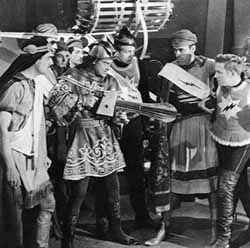

The serial's real focus is on the city of Murania, represented by a surprisingly detailed miniature, and by some great, huge-looking futuristic sets. You can count on the fingers of one hand all the super-scientific future cities we ever got a glimpse of in the early 1950s, either on film or TV, and Murania is at the top of the list. As presided over by the regal Queen Tika (icy blonde Dorothy Christy, who also portrays Stan Laurel's terrifying wife in SONS OF THE DESERT), Murania is a hotbed of cardboard robots, scheming noblemen, mad scientists, and labs full of giant levers, spinning dynamos, gigantic pistons, spheres emitting large sparks, bubbling chemical retorts, flickering gauges, giant rayguns, huge TV screens, welding torches that emit 6-foot flames, and other high-tech wonders. Almost every detail of Murania is surpassingly strange. One aspect that delighted me and my brother when we saw it in the early 1950s is that whenever a recently-dead corpse is returned to life, by the marvelous medical technology of Murania, he speaks incomprehensible words --"The language of the dead," as the chief scientist helpfully explains! (doctors in Murania wear black instead of white surgical outfits!)
For reasons unknown, Murania has an armored cavalry, the "Thunder Riders," who every once in a while take the miles-long elevator trip to the surface and ride around Gene's ranch. And as a wonderful example of how this serial always piles it on, Frankie and Betsy are leaders of a gang of kids who call themselves the "Junior Thunder Riders," and ride around Gene's ranch too, with water-pails on their heads in imitation of knight's helmets! Frankie even has a workshop/lab just as many kids dreamed of having in 1950, where he dabbles with radio and a chemistry set. Above ground, some gangsters plot to seize Murania for its mineral wealth, while in Murania itself, revolutionaries plot the overthrow of Queen Tika, and the last chapters feature a Muranian civil war with large numbers of exotically-costumed extras! This is truly a serial that touches all the bases, each more than once.
 In the leading role, Gene Autry is extremely likable and unassuming. The audience cares deeply what happens to him, despite the often absurd goings-on that surround him. For him, it was the auspicious beginning of a long, richly successful movie, radio, TV and recording career. Note too the very subtle chemistry between Gene's character, and Queen Tika. In Gene's later singing westerns, he would win over even the most feisty females just by singing them a little song; probably the serial's only lapse is that he never gets to sing for the Queen!
- Phantom Empire - Chapter 1: Singing Cowboy
- Phantom Empire - Chapter 2: Thunder Riders
- Phantom Empire - Chapter 3: Lightning Chamber
- Phantom Empire - Chapter 4: Phantom Broadcast
- Phantom Empire - Chapter 5: Beneath the Sky
- Phantom Empire - Chapter 6: Disaster From the Sky
- Phantom Empire - Chapter 7: From Death to Life
- Phantom Empire - Chapter 8: Jaws of Jeopardy
- Phantom Empire - Chapter 9: Prisoners of the Ray
- Phantom Empire - Chapter 10: Rebellion
- Phantom Empire - Chapter 11: Queen in Chains
- Phantom Empire - Chapter 12: End of Murania

Sunday, August 22, 2010
Subscribe to:
Posts (Atom)