
Showing posts with label Crackpot Eccentric Armchair Philosopher. Show all posts
Showing posts with label Crackpot Eccentric Armchair Philosopher. Show all posts
Wednesday, February 18, 2015

Wednesday, May 8, 2013
A Mathematicians Miscellany by J. E. Littlewood (1953)
"Charles Darwin had a theory that once in a while one should perform a damn-fool experiment. It almost always fails, but when it does come off is terrific.
"Darwin played the trombone to his tulips. The result of this particular experiment was negative."

Saturday, September 17, 2011
Suspiria De Profundis by Thomas De Quincey (1891)

GENERAL INTRODUCTION | xi | ||
| SUSPIRIA DE PROFUNDIS: | |||
| Introduction, with Complete List of the 'Suspiria' | 1 | ||
| 1. | The Dark Interpreter | 7 | |
| 2. | The Solitude of Childhood | 13 | |
| 3. | Who is this Woman that beckoneth and warneth me from the Place where she is, and in whose eyes is Woeful Remembrance? I guess who she is | 16 | |
| 4. | The Princess who overlooked one Seed in a Pomegranate | 22 | |
| 5. | Notes for 'Suspiria' | 24 |
Saturday, September 25, 2010
Wednesday, September 22, 2010
Henry Darger, The Vivian Girls and The Realms of the Unreal
 At the folk art museum.
Hidden in Henry's Room: The Secret Life of a Janitor
Google Images.
"At the heart of Darger’s work is the massive tale, The Story of the Vivian Girls, in what is Known as the Realms of the Unreal, of the Glandeco-Angelinian War Storm, Caused by the Child Slave Rebellion. Begun around 1910, In the Realms of the Unreal took Darger over twenty years to complete and provided the foundation for his art for the rest of his life. The story follows the misadventures of his seven heroines—the Vivian sisters, aged five to eight—as they fight countless battles in a war of good against evil.
Through tracing, carbon copying, and collage, Darger appropriated elements of popular culture to create the mural-sized collages and drawings that illustrated the fantastical scenes of In the Realms of the Unreal . He lifted settings, figures, flora, and fauna from children’s books, comics, newspapers, and magazines. Breathing life info the figures, he added personalized touches that divorced them from their original contexts: little girls gained penises or were given bird or butterfly wings and ram horns to form “Blengiglomeanean Spirits,” creatures who aided the Vivian girls in battle.
Darger was a fervent collector, and his one bedroom apartment was filled with his writings, art, and source materials. His complex drawings, which were stitched together to form compositions up to nine and a half feet in length, were so large that they could not be opened in the small apartment. Instead, they were stored in a stack on the artist’s bed; Darger himself slept in a chair. Yet there was an underlying order to this seemingly chaotic environment. Darger’s attention to detail can be seen in the way he handled his supplies. He attached individual labels to small paint pots to identify the colors inside. He gave whittled down pencils extending devices so that every last stub could be used. He transformed coloring books or even city phonebooks into receptacles for his collected imagery, filling every page with clippings and bundling the scrapbooks in stacks bound by twine." Source.
Saturday, September 18, 2010

Friday, September 17, 2010
A Can-Can on the Tightrope of Logic (Notes on Eccentrism)
From the good folks at Toronto culture blog: Back to the World.
by Chris Randle
Most of the radical modernist ideas circulating in 1920s Russia, whether Alexandra Kollontai’s Soviet feminism or extreme forms of artistic abstraction, were snuffed out scant years later by Stalinist repressions. Eccentrism wilted from lack of interest. I came across the short-lived movement’s hyperactive manifesto last week. In the introduction to that republished edition, translator Marek Pytel writes that its original 1922 printing was limited to 1000 copies; many were destroyed in a house fire. The Eccentrists did find some temporary popularity, or at least notoriety: Pytel describes them “disrupting the performances of ‘academic’ theatres with whistles, rattles and catcalls…they astounded guest speakers rash enough to mention the words ‘sentiment’ or ‘emotion’ by smashing every stick of furniture in the place.” Punk rock?
The basic Eccentrist thesis was that Charlie Chaplin and Buster Keaton represented the truest avant-garde yet seen. Slapstick’s physical impossibilities were a model for political aspiration. I imagine this got a lot of contemporary reactions akin to the early gnostic sect which believed that Cain was Christianity’s real martyr. One member of “the Factory of the Eccentric Actor” (FEKS) wrote: “life requires art that is hyperbolically crude, stupendous, nerve-wracking, openly utilitarian, mechanically-precise, momentary, rapid.” They openly urged “Americanization” of the theatre. The implication was that the masses will be their own vanguard, artistic or otherwise.
The central Eccentric text can be maddening reading – its authors were all young men (a couple still teenagers), and even by manifesto standards their rhetoric sometimes overheats. At one point they declare: “THE 200 VOLUMES OF GERMAN EXPRESSIONISM DO NOT OFFER THE EXPRESSIVITY OF ONE SOLE CIRCUS POSTER!!!” There are several citations of Filippo Tommaso Marinetti, a like-minded Italian Futurist whose aesthetic fixation on speed, violence and machinery soon led him to stridently support Mussolini. Not long after the FEKS manifesto was published, Marinetti argued that “imposition of [Italian empire] will be an act of faith-force, a defiant youthful improvisation, a work of art miraculously blossoming.”
But the Eccentrists didn’t turn totalitarian, perhaps because they were too playful for that. Their theoretical writings are remarkably sly and self-mocking; they charm rather than bellow. A typical slogan says: “Charlie’s bum is more precious to us than Eleonora Duse!” They exalted roller skates over ballet pumps, and declared themselves the children of jazz bands, slang, torch singers, cinema, dance crazes and cheap pulp thrillers – might as well throw Marx and Coca-Cola in too. They once distributed their manifesto by randomly tossing it from a moving car. They’re very easy to like.

Although that original Eccentrist document had little immediate influence, several of its main authors continued experimenting with these ideas in the nascent Soviet film industry. Most of their ’20s productions are lost, and I haven’t watched any of the survivors. But I know that affection for mass culture became a broader intellectual trend over the period. Socialist utopias were explored in literally hundreds of SF novels and “Red Pinkerton” detective thrillers (lone Soviet blockbuster Aelita, Queen of Mars posited extraterrestrial revolution amidst Constructivist sets). Shostakovich wrote the score for one Eccentric-directed picture. Eisenstein shook hands with Mickey Mouse. You could place all this near the beginning of a narrative about shifting notions of cultural taste, one extending onwards to Warhol and camp and music-critic “poptimism.”
If that story doesn’t quite have a happy ending, at least it’s a fruitfully confusing one. Whereas the Soviet experiment congealed into a lethal bureaucracy, for art and so much else, after one chaotic decade. You can see it coming onscreen. From what I’ve read, the Eccentrists’ later films were identifiably Marxist, but in tense, ambivalent and even subversive ways that would soon be absolutely verboten. In 1927 director Abram Room, who knew the Eccentrics Grigori Kozintsev and Leonid Trauberg, made Bed and Sofa. It’s about a revolutionary young menage-a-trois who try to love one another as communists before realizing they can’t. The USSR’s film industry devolved into grotesque spectacles like 1949′s The Fall of Berlin, a WWII epic I stared at for three hours in a class last year; in one scene Stalin tells the lovelorn hero “don’t be afraid of poetry.”
There’s a DC Comics outfit called the Doom Patrol, a trashy superhero team that the Eccentrists probably would’ve dug. Each member was a freakish misfit, maimed, traumatized or alienated from society during the same event that gave them bizarre powers. The characters were relaunched multiple times until a new creative team took over in the late ’80s and infected the series with psychedelia, conspiracism and copious Burroughs.
Their new arch-foes were the Brotherhood of Dada, supervillains with a grudge against “consensus reality,” whose totally irrational schemes included transforming Paris into a giant artwork and mounting a surreal presidential campaign via the lysergic resonance of Albert Hofmann’s bicycle. The Brotherhood’s creator has said that he felt forced to kill them off when they became more popular than his ostensible heroes. I mention all this because it sounds like the logic that Stalin applied to actual artistic eccentrics. In 1949 Leonid Trauberg was fired as director of the studio Lenfilm. His offense? Being “a leader of cosmopolitanism.”
by Chris Randle
Most of the radical modernist ideas circulating in 1920s Russia, whether Alexandra Kollontai’s Soviet feminism or extreme forms of artistic abstraction, were snuffed out scant years later by Stalinist repressions. Eccentrism wilted from lack of interest. I came across the short-lived movement’s hyperactive manifesto last week. In the introduction to that republished edition, translator Marek Pytel writes that its original 1922 printing was limited to 1000 copies; many were destroyed in a house fire. The Eccentrists did find some temporary popularity, or at least notoriety: Pytel describes them “disrupting the performances of ‘academic’ theatres with whistles, rattles and catcalls…they astounded guest speakers rash enough to mention the words ‘sentiment’ or ‘emotion’ by smashing every stick of furniture in the place.” Punk rock?
The basic Eccentrist thesis was that Charlie Chaplin and Buster Keaton represented the truest avant-garde yet seen. Slapstick’s physical impossibilities were a model for political aspiration. I imagine this got a lot of contemporary reactions akin to the early gnostic sect which believed that Cain was Christianity’s real martyr. One member of “the Factory of the Eccentric Actor” (FEKS) wrote: “life requires art that is hyperbolically crude, stupendous, nerve-wracking, openly utilitarian, mechanically-precise, momentary, rapid.” They openly urged “Americanization” of the theatre. The implication was that the masses will be their own vanguard, artistic or otherwise.
The central Eccentric text can be maddening reading – its authors were all young men (a couple still teenagers), and even by manifesto standards their rhetoric sometimes overheats. At one point they declare: “THE 200 VOLUMES OF GERMAN EXPRESSIONISM DO NOT OFFER THE EXPRESSIVITY OF ONE SOLE CIRCUS POSTER!!!” There are several citations of Filippo Tommaso Marinetti, a like-minded Italian Futurist whose aesthetic fixation on speed, violence and machinery soon led him to stridently support Mussolini. Not long after the FEKS manifesto was published, Marinetti argued that “imposition of [Italian empire] will be an act of faith-force, a defiant youthful improvisation, a work of art miraculously blossoming.”
But the Eccentrists didn’t turn totalitarian, perhaps because they were too playful for that. Their theoretical writings are remarkably sly and self-mocking; they charm rather than bellow. A typical slogan says: “Charlie’s bum is more precious to us than Eleonora Duse!” They exalted roller skates over ballet pumps, and declared themselves the children of jazz bands, slang, torch singers, cinema, dance crazes and cheap pulp thrillers – might as well throw Marx and Coca-Cola in too. They once distributed their manifesto by randomly tossing it from a moving car. They’re very easy to like.

Although that original Eccentrist document had little immediate influence, several of its main authors continued experimenting with these ideas in the nascent Soviet film industry. Most of their ’20s productions are lost, and I haven’t watched any of the survivors. But I know that affection for mass culture became a broader intellectual trend over the period. Socialist utopias were explored in literally hundreds of SF novels and “Red Pinkerton” detective thrillers (lone Soviet blockbuster Aelita, Queen of Mars posited extraterrestrial revolution amidst Constructivist sets). Shostakovich wrote the score for one Eccentric-directed picture. Eisenstein shook hands with Mickey Mouse. You could place all this near the beginning of a narrative about shifting notions of cultural taste, one extending onwards to Warhol and camp and music-critic “poptimism.”
If that story doesn’t quite have a happy ending, at least it’s a fruitfully confusing one. Whereas the Soviet experiment congealed into a lethal bureaucracy, for art and so much else, after one chaotic decade. You can see it coming onscreen. From what I’ve read, the Eccentrists’ later films were identifiably Marxist, but in tense, ambivalent and even subversive ways that would soon be absolutely verboten. In 1927 director Abram Room, who knew the Eccentrics Grigori Kozintsev and Leonid Trauberg, made Bed and Sofa. It’s about a revolutionary young menage-a-trois who try to love one another as communists before realizing they can’t. The USSR’s film industry devolved into grotesque spectacles like 1949′s The Fall of Berlin, a WWII epic I stared at for three hours in a class last year; in one scene Stalin tells the lovelorn hero “don’t be afraid of poetry.”
There’s a DC Comics outfit called the Doom Patrol, a trashy superhero team that the Eccentrists probably would’ve dug. Each member was a freakish misfit, maimed, traumatized or alienated from society during the same event that gave them bizarre powers. The characters were relaunched multiple times until a new creative team took over in the late ’80s and infected the series with psychedelia, conspiracism and copious Burroughs.
Their new arch-foes were the Brotherhood of Dada, supervillains with a grudge against “consensus reality,” whose totally irrational schemes included transforming Paris into a giant artwork and mounting a surreal presidential campaign via the lysergic resonance of Albert Hofmann’s bicycle. The Brotherhood’s creator has said that he felt forced to kill them off when they became more popular than his ostensible heroes. I mention all this because it sounds like the logic that Stalin applied to actual artistic eccentrics. In 1949 Leonid Trauberg was fired as director of the studio Lenfilm. His offense? Being “a leader of cosmopolitanism.”
Tuesday, September 14, 2010
Edward Gorey - Poems, Stories Online and Miscellania
- Poems by Edward Gorey
- The Disrespectful Summons (In full, with Illustrations)
- The Doubtful Guest (In full, with Illustrations)
- The Raging Tide (In full, with Illustrations)
- The Wuggly Ump (In full, with Illustrations)
- The Insect God
- Gashlycrumb Tinies (Text only)
- * Same, with original Illustrations
- Limericks
- "There was a young curate whose brain/ Was deranged from the use of cocaine;"
- Scans from "The Recently Deflowered Girl."
- When Edward Gorey Illustrated Dracula: Two Masters of the Macabre, Together
- T. S. Eliot’s Iconic Vintage Verses About Cats, Illustrated and Signed by Edward Gorey

Flip Through Gorey Titles Cheaply and as Loudly as You Wish on Amazon
- Amphigorey (Perigee)
- The Twelve Terrors of Christmas
- The Doubtful Guest
- The Recently Deflowered Girl: The Right Thing to Say on Every Dubious Occasion
- The Epiplectic Bicycle
- The Blue Aspic
- The West Wing
- The Other Statue
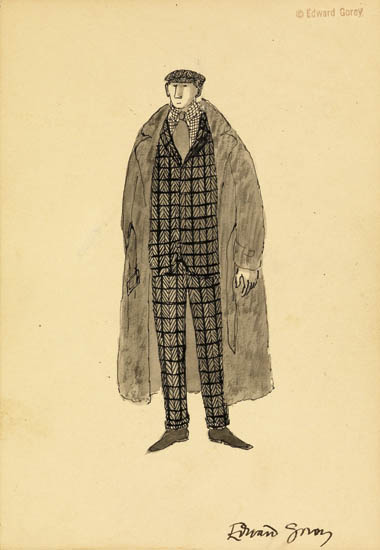
Gorey Costume Design
for Jonathan Harker, Dracula - The Hapless Child
- The Remembered Visit: A Story Taken from Life
- The Black Doll: A Silent Screenplay
- The Curious Sofa: A Pornographic Work by Ogdred Weary
- Edward Gorey's Dracula: A Toy Theatre: Die Cut, Scored and Perforated Foldups and Foldouts
- The Haunted Looking Glass (New York Review Books Classics)
- The Willowdale Handcar: or the Return of the Black Doll
- The Glorious Nosebleed
- The Eclectic Abecedarium
- Cautionary Tales for Children
- The Gilded Bat
- The Utter Zoo: An Alphabet by Edward Gorey
- The Headless Bust: A Melancholy Meditation for the False Millennium
- The Haunted Tea-Cosy: A Dispirited and Distasteful Diversion for Christmas
- The Unstrung Harp
- The Iron Tonic: Or, A Winter Afternoon in Lonely Valley
- The War of the Worlds
- The Wuggly Ump
- The Dong with a Luminous Nose

Miscellania
- PBS Interview
- Quotes
- Fantod Deck (Online Tarot Deck, Gorey's Illustrations)
- Edward Gorey’s Letters and Illustrated Envelopes
- The Betrayed Confidence: Edward Gorey’s Weird and Whimsical Vintage Illustrated Postcards
Revenge of the Virgins
Clearly Ed Wood does not set out to create or encourage Art. The films are scantly even commercial B-fair: perverse, idiosyncratic enough likely to irritate the audience of titillation-seekers who would naturally be his, did they not generally require a semantically more even-keeled thrill. With this in mind, here is a badly executed western with one glaring, additional gimmick: the "indians" are, to a person, topless showgirls. There's even a blond one!
Thursday, September 9, 2010



Wednesday, September 8, 2010

Sunday, August 22, 2010
Alice's Adventures in Wonderland
In full, with original illustrations, at project Gutenberg.
 I Down the Rabbit-Hole
II The Pool of Tears
III A Caucus-Race and a Long Tale
IV The Rabbit Sends in a Little Bill
V Advice from a Caterpillar
VI Pig and Pepper
VII A Mad Tea-Party
VIII The Queen's Croquet-Ground
IX The Mock Turtle's Story
X The Lobster Quadrille
XI Who Stole the Tarts?
XII Alice's Evidence
c/f 1903 film version . . . .

II The Pool of Tears
III A Caucus-Race and a Long Tale
IV The Rabbit Sends in a Little Bill
V Advice from a Caterpillar
VI Pig and Pepper
VII A Mad Tea-Party
VIII The Queen's Croquet-Ground
IX The Mock Turtle's Story
X The Lobster Quadrille
XI Who Stole the Tarts?
XII Alice's Evidence
c/f 1903 film version . . . .
Monday, August 16, 2010
Lear, Edward: Illustrations of the family of Psittacidae, or parrots: the greater part of them species hitherto unfigured, containing forty-two lithographic plates, drawn from life, and on stone
Source.
 Edward Lear, popularizer of limerick, Victorian purveyor of nonsense, founding crackpot for the next century's middlebrow cocktail verse, was also an exacting naturalist. I am wagering that it is within character that his choice for study, here, was parrots.
 Edward Lear, popularizer of limerick, Victorian purveyor of nonsense, founding crackpot for the next century's middlebrow cocktail verse, was also an exacting naturalist. I am wagering that it is within character that his choice for study, here, was parrots.
Saturday, August 14, 2010
Rube Goldberg's Artwork
A site dedicated to Rube Goldberg, the unlikely prophet of systems complexity.


Rube Goldberg mistakes a lot of broken glass for bath salts and when they pull him out of the tub he mumbles an idea for dodging bill collectors As Tailor (A) fits customer (B) and calls out measurements, college boy (C) mistakes them for football signals and makes a flying tackle at clothing dummy (D). Dummy bumps head against paddle (E) causing it to pull hook (F) and throw bottle (G) on end of folding hat rack (H) which spreads and pushes head of cabbage (I) into net (J). Weight of cabbage pulls cord (K) causing shears (L) to cut string (M). Bag of sand (N) drops on scale (O) and pushes broom (P) against pail of whitewash (Q) which upsets all over you causing you to look like a marble statue and making it impossible for you to be recognized by bill collectors. Don't worry about posing as any particular historical statue because bill collectors don't know much about art.
Monday, August 2, 2010
Ogden Nash
 A fairly extensive catalog of poems online here.
Daffy, vocabulary drunk, middle-aged witty, these are dippy, doughy, dumpy exemplars of the last centuries' middle-of-the-road cocktail verse. The nearest thing the 20C had to a popular verse, without the rhymes being set to music.

A Lady Who Thinks She Is Thirty
Unwillingly Miranda wakes,
 |
| Aubrey Beadsley - Venus |
Feels the sun with terror,
One unwilling step she takes,
Shuddering to the mirror.
Miranda in Miranda's sight
Is old and gray and dirty;
Twenty-nine she was last night;
This morning she is thirty.
Shining like the morning star,
Like the twilight shining,
Haunted by a calendar,
Miranda is a-pining.
Silly girl, silver girl,
Draw the mirror toward you;
Time who makes the years to whirl
Adorned as he adored you.
Time is timelessness for you;
Calendars for the human;
What's a year, or thirty, to
Loveliness made woman?
Oh, Night will not see thirty again,
Yet soft her wing, Miranda;
Pick up your glass and tell me, then--
How old is Spring, Miranda?
Subscribe to:
Posts (Atom)